


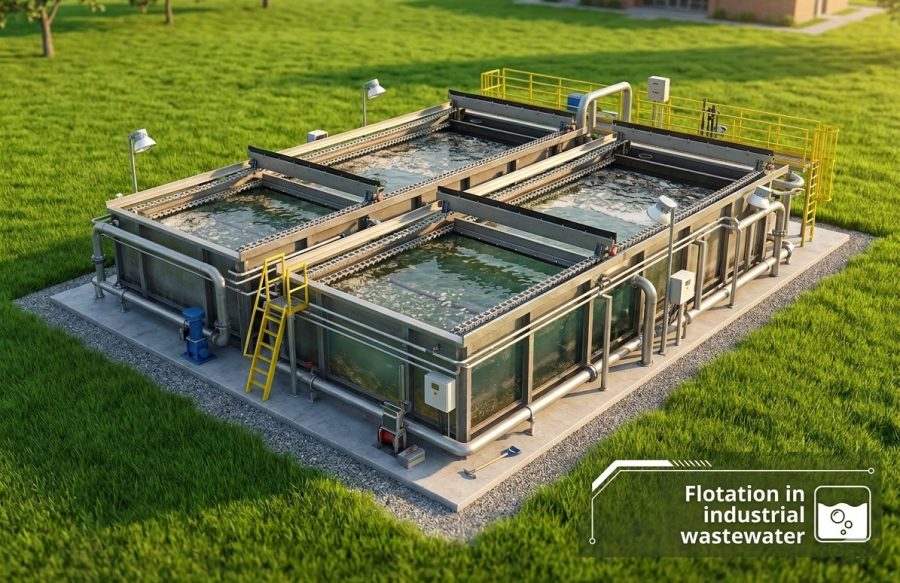
In industrial wastewater treatment, not all contaminants behave in the same way: some tend to settle at the bottom, others remain suspended, while others float or form emulsions that are difficult to separate. It is precisely in these cases that a flotation plant can become a particularly effective solution.
Flotation refers to a physico-chemical separation process used to remove substances that cannot be effectively eliminated through preliminary treatment or simple sedimentation. In the presence of oils, fats, light suspended solids, flocs, and low-density particles, a flotation plant can improve effluent quality and stabilize the performance of downstream treatment stages.
This solution is widely used across different industrial sectors, from food processing to chemical industries, as well as in metal surface treatment and energy plants. To understand when it is truly effective, it is important to clarify what flotation is, how a flotation plant works, and what should be considered during the design phase.
What Is flotation in wastewater treatment
Flotation is a process that separates solid or liquid particles from water by promoting their rise to the surface. Unlike sedimentation, which relies on gravity to settle heavier materials, flotation works in the opposite direction: it brings to the surface particles that can attach to microbubbles or have a lower density than water.
The principle is simple. Fine air bubbles are generated within the wastewater and attach to the particles to be removed. When adhesion is effective, the particle-bubble system becomes lighter and rises to the surface, forming a floating layer that can be collected and removed.
Although the concept is straightforward, flotation should not be considered an “automatic” step. The performance of a flotation plant depends on several parameters, including wastewater characteristics, bubble size, contact time, correct dosing of chemicals, and flow stability. For this reason, a flotation system must be properly integrated within the overall treatment process.
What is a flotation plant used for
A flotation plant is used when the goal is to separate contaminants that remain dispersed in wastewater and are not effectively removed by sedimentation alone.
Common cases include:
- Dispersed oils and fats
- Fine suspended solids
- Flocs from coagulation and flocculation processes
- Colloidal substances
- Light materials that remain in suspension
In these situations, a flotation plant can be used as an advanced primary treatment, as an intermediate step before biological treatment, or as a dedicated unit for specific process streams.
Its role is particularly important because it reduces the pollutant load on downstream sections. Removing oils, fats, and suspended solids early improves operational stability, reduces process issues, and enhances the overall efficiency of the wastewater treatment plant.
How a flotation plant works
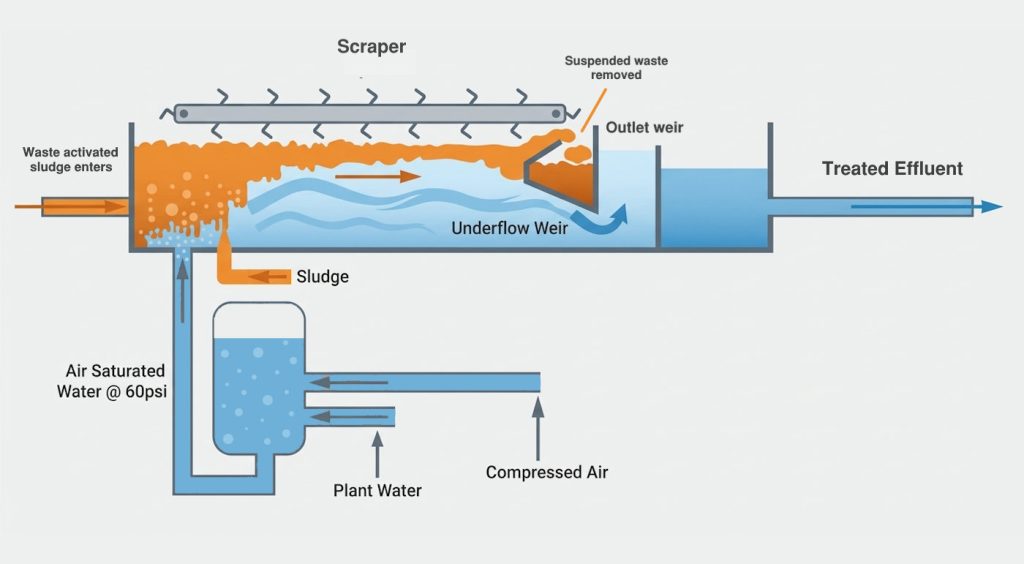
To understand how a flotation plant works, it is necessary to focus on the interaction between air bubbles and contaminants present in the wastewater. The process involves generating microbubbles that come into contact with particles. When adhesion occurs, the apparent density decreases, and the particles rise to the surface.
At the top of the tank, a floating sludge layer forms and is removed by mechanical skimming systems, while clarified water flows to the next treatment stage.
In many cases, flotation is supported by a chemical conditioning phase. Coagulants and flocculants help destabilize emulsions, aggregate particles, and enhance separation. This means that performance depends not only on air injection but also on the correct balance between chemical, hydraulic, and process parameters.
For this reason, the key question is not simply “does it work?”, but rather: “Has the wastewater been properly analyzed?“, “Are the process variables well understood?“, “Has the flotation plant been designed according to the actual characteristics of the effluent?“
Dissolved Air Flotation (DAF): what it means
When discussing flotation systems, the term DAF (Dissolved Air Flotation) is frequently used. In this configuration, air is dissolved in water under controlled conditions and then released as microbubbles, which attach to particles and promote their separation.
The principle remains the same as flotation, but the term DAF is important because it identifies one of the most widely used technologies for treating wastewater containing oils, fats, fine suspended solids, and flocs generated by physico-chemical treatments.
From a design and documentation perspective, using the correct terminology—such as DAF—helps clearly define the selected technology and its role within the treatment process.
Flotation vs Sedimentation: key differences
Flotation and sedimentation are not equivalent technologies. Both are used to separate contaminants from water, but they rely on different principles and are suited to different conditions.
Sedimentation is effective when particles have sufficient density to settle within a reasonable time. Flotation, on the other hand, is more suitable when materials are too light, too fine, or too stable to settle effectively.
In practice if the contaminant tends to sink sedimentation is suitable, if it remains dispersed or can attach to bubbles flotation is more effective.
In real plants, the choice is not always either/or. It depends on wastewater characteristics, treatment objectives, and the role of each stage within the overall process.
When to use a flotation plant in industrial wastewater
A flotation plant is particularly useful when wastewater characteristics make conventional separation ineffective. Typical cases include high presence of oils and fats, wash water with dispersed contaminant, streams requiring rapid reduction of suspended solids
It is also beneficial when it is necessary to:
- Protect biological treatment from overload
- Improve operational stability
- Separate light flocs from chemical treatments
- Handle wastewater with significant variability over time
However, a common mistake is to consider flotation as a universal solution. Its effectiveness depends on proper application and design based on reliable data. Using a flotation plant without a clear analysis can lead to poor performance or oversized systems.
Applications of flotation in industry
Flotation plants are used in a wide range of industries, particularly where wastewater contains oils, fats, surfactants, organic residues, or fine suspended solids.
Typical applications include:
- Food industry
- Chemical industry
- Metal surface treatment
- Petrochemical sector
- Energy plants
- Process and wash water treatment
Each sector has specific requirements. In some cases, the main issue is oily substances; in others, colloidal particles or process variability. For this reason, there is no universal configuration. Designing a flotation plant must always be based on real data and clearly defined objectives.
In medium-small plants, common in many water treatment applications, the key difference often lies in the ability to manage the project in a structured yet simple way: fewer manual steps, fewer inconsistencies, and better control over lines, instruments, and process data.
What to consider when designing a flotation plant
Designing a flotation plant starts with defining the problem to be solved, not with selecting equipment or tank geometry. This requires collecting reliable data on average and peak flow rates, wastewater composition, variability over time, required output quality, existing upstream or downstream treatments
From a design perspective, several aspects directly impact the final result.
Dal punto di vista progettuale, ci sono alcuni aspetti che incidono direttamente sulla qualità del risultato.
The first is process data quality. Incomplete or generic data leads to inaccurate technology selection. Flow rates, variability, and treatment objectives must be clearly defined from the beginning.
The second is consistency between process design and plant configuration. A flotation system may work on paper but become difficult to manage if piping, recirculation, dosing, instrumentation, and maintenance are not properly considered. In this context, the P&ID is not just a drawing but a tool to organize data and ensure consistency.
The third is technical documentation management. In real plants, flotation interacts with pumps, chemicals, instruments, tanks, and downstream processes. If data, diagrams, and piping are not aligned, revisions become time-consuming and error-prone. This is why tools like ESAPRO P&ID can support a more structured workflow.
The fourth aspect is the continuity between what is defined in the process diagram and what is later developed using piping design software. This is often the stage where inconsistencies, manual checks, and time losses begin to emerge, especially when revisions have cascading effects on documentation, materials, and piping development. For this reason, in projects where P&IDs and the 3D model must remain aligned throughout the entire engineering lifecycle, maintaining consistency across the different phases of the work becomes particularly important, as shown in the Idrosistem case study.
Operational flexibility must also be taken into account, especially in medium-small plants, where wastewater variability may require adjustments and revisions over time.
Common mistakes to avoid
One of the most common mistakes is underestimating the preliminary phase and treating flotation as a default solution. Without proper wastewater characterization, the result may be ineffective or misaligned with process goals
Another issue is fragmented information management. When process diagrams, technical data, piping, and instrumentation are not coordinated, modifications become slow and complex.
A frequently overlooked aspect is the difference between drawing and designing. In wastewater treatment, it is not enough to represent a flotation tank—data, symbols, lines, and components must be connected in a structured way to avoid manual recalculations, inconsistencies, and uncontrolled revisions.
Why flotation matters for plant design
Flotation may seem like a specific technology, but it highlights key challenges in plant design: data collection, process definition, interdisciplinary coordination, revision management, and documentation clarity.
For this reason, it is not only relevant for plant operators but also for engineers who design, update, and manage industrial plants efficiently.
In industrial wastewater treatment, an effective solution comes from combining process knowledge with the right tools to translate it into a structured design. This is where engineering quality makes a difference—not only in plant performance, but also in development time, revision management, and the ability to maintain consistency between data, process diagrams, and piping throughout the entire project lifecycle.


