• About us
en
ites
  • Plant Design Software
    • ESAPRO Suite
      • Process Design
      • Plant Design
      • Electrical Design
      • Add-ons
    • Resold Products
  • Training and Support
  • Case histories
  • About us
  • News
    • All
    • News
    • Magazine
  • Contact
    • Contact us
    • Request Demo
    • Work with us
Request Demo
Magazine

PIMM: Plant Information Modeling & Management for Industrial Plants

Posted on 3 Jul at 10:52
Francesco Pais
PIMM Plant Information Modeling & Management as a connection between BIM and the industrial Digital Twin

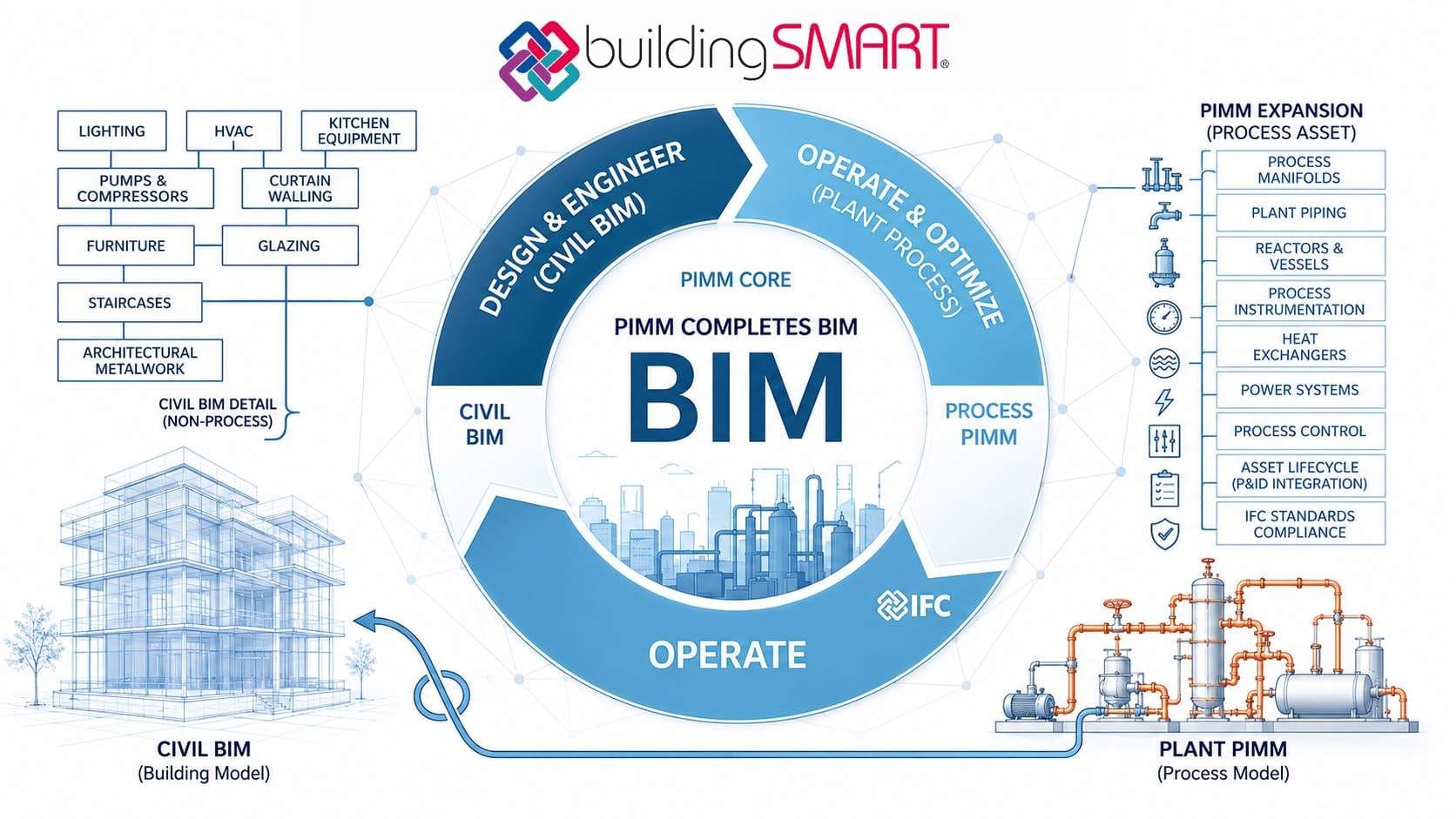
PIMM, Plant Information Modeling & Management, was created to provide information management that better fits the needs of industrial plants. In plant design projects, the value of the model does not depend only on geometry, but on the consistency between P&IDs, TAGs, piping data, 3D models, datasheets, IFC and technical documentation. PIMM does not replace BIM: it complements it in the management of the plant’s technological content, connecting process data, the federated model and the asset lifecycle.

In digital design, BIM introduced a fundamental change: the model is no longer only a geometric representation, but becomes a container of information that supports design, construction and asset management over time.

This approach has delivered major benefits in the civil, architectural and infrastructure sectors. However, when the information model is applied to industrial plants, process plants, piping networks, water treatment systems, energy plants or waste-to-energy facilities, specific needs emerge.

An industrial plant is not simply a building that contains pipes, equipment and instruments. It is a complex technical system governed by process logic, engineering data, line specifications, TAGs, P&IDs, datasheets, isometrics, bills of materials and maintenance documentation.

This is why the concept of PIMM, Plant Information Modeling & Management, becomes relevant.

If BIM manages the spatial and informational container of the asset, PIMM helps structure the plant’s technological content: the information that describes how the system works, how it is built, how it is updated and how it can be managed over time.

From this perspective, PIMM can also be seen as a connecting layer between BIM and the industrial Digital Twin. It does not intervene only at the end of the project, when the plant has to be handed over and managed, but helps build a consistent information base from the very beginning, connecting design to the future operation of the asset.

What is PIMM?

Plant Information Modeling & Management is an approach to digital information management applied to industrial and process plants.

It is not a regulatory standard, it is not a file format and it is not a single proprietary software platform. It is an open, software-agnostic methodological approach designed to structure, connect and validate industrial plant information within an interoperable digital ecosystem.

Its goal is to connect, in a consistent way:

  • P&ID diagrams and process data;
  • equipment, valve and instrument TAGs;
  • line lists and piping classes;
  • 3D plant models;
  • isometric sketches and bills of materials;
  • technical datasheets;
  • project, construction and maintenance documentation;
  • information useful for the future Digital Twin and O&M management.

Many PIMM principles are consistent with the information management already found in BIM processes. The difference lies in the specialization of the information content: in industrial plants, critical information is not only spatial or construction-related, but also derives from process, piping, specifications, technical documentation and operational logic.

In a PIMM workflow, 3D geometry is not an isolated element: it is connected to an information structure in which every change to the process, lines, valves or instruments can affect documentation, materials, isometrics, layout, maintenance and operational safety.

Why BIM alone may not be enough for industrial plants

In its most common application in AEC, BIM is often used to manage buildings, infrastructure, spaces, structures, building components and coordination between disciplines.

In industrial plants, however, the focus of the project is often different.

The question is not only: “Where is this object in the model?”, but also: “Which P&ID is it connected to?”, “Which fluid does it carry?”, “What is its piping class?”, “Which datasheet describes it?” and “How will it be managed during operation?”

A 3D model can be correctly coordinated from a geometric point of view and, at the same time, lack the information needed to support construction, commissioning or plant maintenance.

For an industrial plant, a “clash free” model is not necessarily a model ready to be built or managed. Spatial consistency is essential, but it must be supported by engineering consistency: this is where PIMM becomes relevant.

From BIM to Digital Twin: the data handover challenge

One of the most discussed topics in asset digitalization is the relationship between BIM and Digital Twin. In many projects, BIM mainly supports design and construction, while the Digital Twin is associated with asset operation, integrating data from sensors, maintenance, IoT platforms and monitoring systems.

The transition between these two worlds is not always automatic.

At the end of construction, the information model should become a useful base for operation and maintenance. However, if data has not been properly structured from the earliest stages, handover can become complex, costly and partly manual: information must be retrieved, documents linked, attributes normalized, coding systems checked and systems integrated.

In the civil sector, this issue is already relevant. In industrial plant engineering it can become even more critical, because the operational value of the asset depends on very specific technical information: P&IDs, TAGs, piping classes, process data, datasheets, isometrics, materials, revisions and maintenance logic.

PIMM helps reduce this gap because it does not consider the Digital Twin as an information layer to be built only at the end of the project. Instead, it promotes consistent data management starting from the first process diagram, so that the engineering intelligence of the plant is maintained throughout its lifecycle.

In other words, while the 3D model represents the spatial configuration of the plant, the connected technical database preserves the logic that makes that plant buildable, verifiable and manageable.
BIM Revit vs Plant Design: overcoming the false alternative

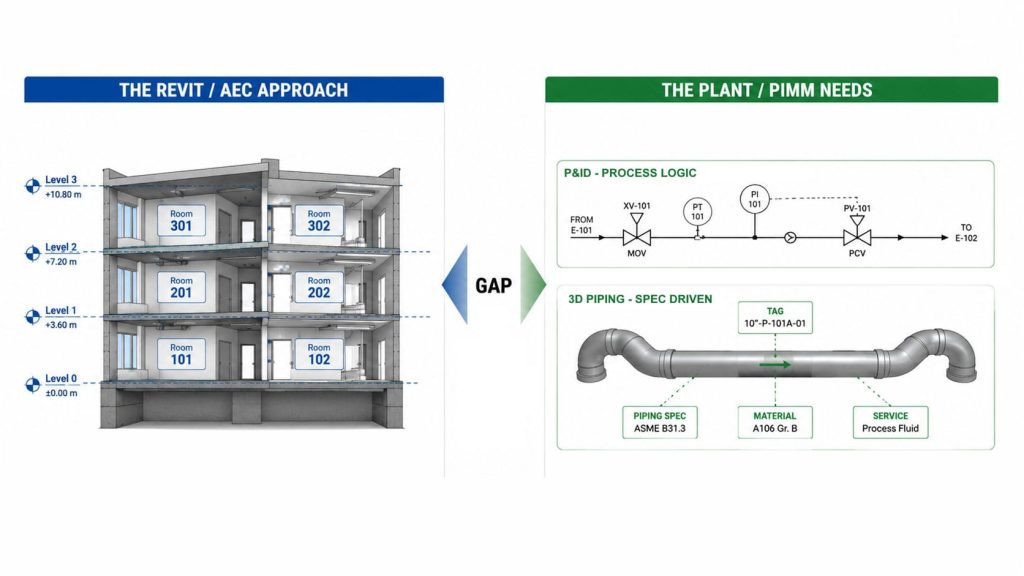
In many industrial projects, a recurring tension emerges: on one side BIM/MEP tools, effective for architecture, structures, spaces and general coordination; on the other, specialist plant design environments, essential for managing piping, line specifications, P&IDs, isometrics and process data.

The risk is that teams are forced to choose between two equally important needs: maintaining control of the federated model or preserving the technical intelligence of the piping network.

BIM tools oriented to the building sector often think in terms of rooms, levels, spaces, families, categories and spatial coordinates. An industrial plant, instead, also thinks in terms of diagrams, lines, fluids, piping classes, pressures, temperatures, TAGs and functional relationships between components.

At the same time, specialist plant design software can generate models, isometrics and technical documentation that are much more aligned with the needs of industrial plant engineering, but they must be able to communicate effectively with the BIM context, the Common Data Environment and the federated model.

PIMM was created to overcome this false alternative. It does not impose a single authoring environment, but defines a method that allows different tools to coexist within a consistent information flow based on open standards and structured technical data.

BIM and PIMM: two complementary approaches

BIM and PIMM should not be seen as two competing worlds.

On the contrary, in a modern industrial project they can coexist within the same federated model, each with its own role.

BIM manages the spatial and informational context of the asset: structures, buildings, foundations, rooms, volumes, interferences and coordination between civil and plant disciplines.

PIMM specializes the information management of the industrial part: P&IDs, piping, equipment, instruments, lines, process data, specifications, datasheets, isometrics and operational information.

Together, they make it possible to describe not only where an object is located, but also what function it performs in the plant, which system it belongs to and which documents make it usable during design, construction and maintenance.

One of the principles of PIMM is authoring freedom: civil and structural teams can continue working in their BIM environments, while process and piping teams can use specialist software designed for industrial plant design. The value comes from integration: each discipline works with the most suitable tools, while information flows into a readable, coordinated and queryable federated model.

The vendor-independent nature of PIMM is particularly useful for clients and owner operators: information requirements can be defined based on the needs of the plant, not on the specific software used by a designer or supplier.

This distinction is particularly important in sectors such as:

  • water treatment;
  • biogas and biomethane;
  • hydrogen;
  • waste to energy;
  • power generation;
  • chemical and pharmaceutical;
  • food & beverage;
  • small and medium-sized process plants.

In these contexts, the plant often includes a significant civil component, but its operational value depends on the correct functioning of the industrial process.

P&ID as the informational core of the plant

In PIMM, the P&ID plays a central role.

In PIMM, the P&ID plays a central role.

The Piping and Instrumentation Diagram is not just a technical drawing. It is the document that represents the process logic of the plant and defines the relationships between lines, equipment, valves, instruments and control systems.

A structured P&ID can provide key information for the entire design workflow:

  • line list;
  • valve list;
  • instrument list;
  • equipment list;
  • process data;
  • connection between TAGs and components;
  • consistency between diagram and 3D model;
  • basis for bills of materials;
  • references for documentation, commissioning and maintenance.

In a PIMM approach, the P&ID does not live as a disconnected graphic file, but as an information source connected to the 3D model, lists, isometrics and technical documentation.

When P&IDs, 3D piping and technical data are separate, manual activities, Excel duplications, inconsistency risks and revision checking times increase.

When information is connected, each update can be managed in a more controlled way, reducing errors and rework.

Lighter models, smarter data

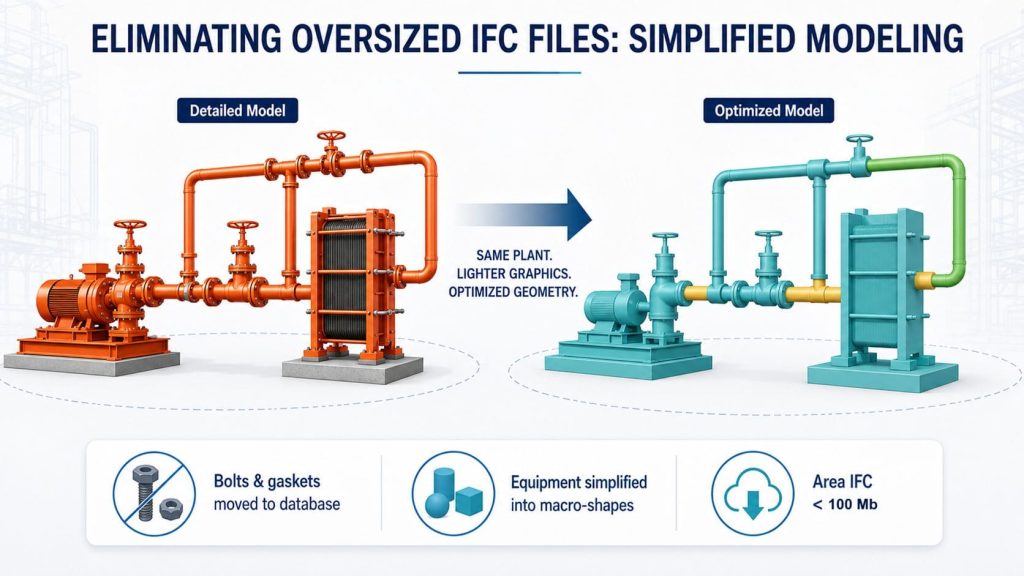
One of the principles of PIMM is to prevent the 3D model from becoming unnecessarily heavy.

In industrial plants, each component can be associated with a large amount of technical information: materials, ratings, nominal diameters, item codes, datasheets, revisions, maintenance documents, test data and operational information. Placing all this complexity directly into the geometry can make the model difficult to manage, heavy to exchange and inefficient to update.

PIMM proposes a more sustainable balance: essential, lightweight and navigable graphic models connected to databases, datasheets and technical documentation.

Valves, instruments, equipment and line components do not necessarily need to be represented with an excessive level of geometric detail. In many cases, what matters is correctly representing envelopes, connections, maintenance spaces and interface points, while keeping technical complexity within structured data and linked documents.

The TAG therefore becomes a key element: it connects the geometric object to its technical identity, reference documentation and functional role within the plant.

The value is not in graphic detail for its own sake, but in the ability to query the system and quickly retrieve the right information.

PIMM, IFC and the federated model

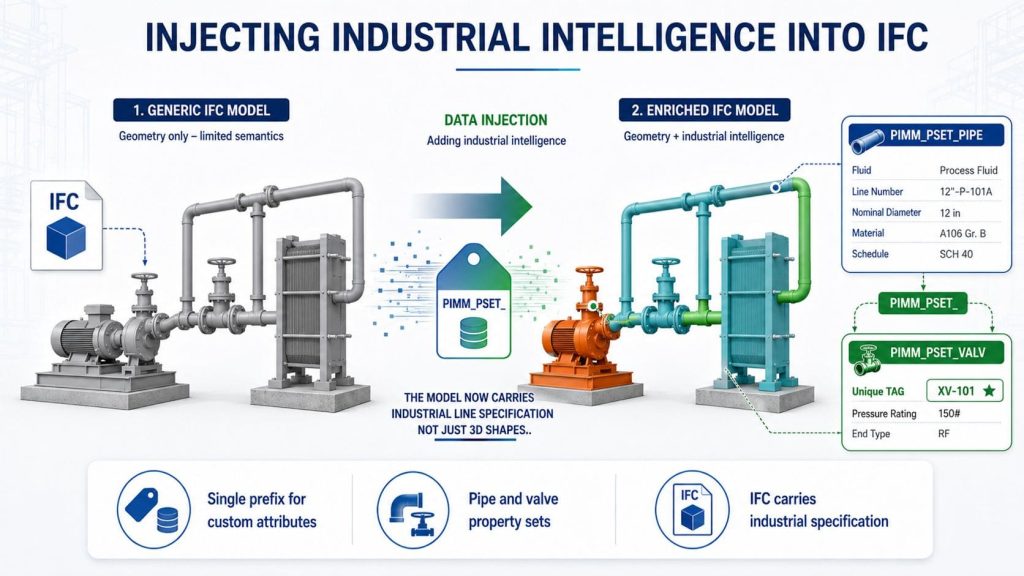
Industrial data injection into IFC through PIMM property sets for piping and valves

An effective PIMM approach must not create a new information silo; on the contrary, it must support integration between different disciplines.

In the federated model, industrial plant information must be able to communicate with the BIM and OpenBIM environments used by other disciplines. The IFC format makes it possible to transfer objects and properties within a shared ecosystem, provided that the information is mapped consistently.

Using IFC is an important condition for interoperability, but it does not automatically solve the information problem. Without a shared structure of attributes, naming rules, consistent mapping and validation checks, the risk is to export geometries that are formally correct but poor in engineering meaning.

In industrial plant engineering, PIMM helps define which information must accompany objects in the federated model through a coherent chain: BIM/PIMM method, open IFC format, exchange classes and dedicated property sets.

For example: a pipe should carry line number, fluid, diameter, material and schedule; a valve should carry TAG, rating, connection and datasheet; equipment should carry TAG, system, function and linked technical documentation.

The point is not to export as much data as possible, but to export the data required by the decisions the model must support: coordination, construction, prefabrication, commissioning, maintenance or asset management.

PIMM and Information Requirements for industrial plants

PIMM can also support the definition of information requirements for industrial plant projects. Specifying from the outset which data must accompany pipes, valves, instruments and equipment helps clients, BIM Managers and designers reduce ambiguity at handover, regardless of the software used.

For a client, the issue is not only requesting a federated model, but defining which information must be available, verifiable and reusable over time: technical attributes, linked documents and consistency rules between P&IDs, 3D model, datasheets, isometrics and project lists.

PIMM as an integration-first approach

One of the main obstacles in building a Digital Twin is integrating data created in different systems: process diagrams, 3D models, stress analysis, technical documentation, datasheets, lists, management systems and maintenance tools.

When environments do not communicate, information risks remaining isolated in proprietary files, separate folders or disconnected Excel sheets. The result is a progressive loss of consistency between what was designed, what was built and what is managed during operation.

PIMM adopts an integration-first logic: it does not start from the idea of concentrating everything in a single software platform, but from the need to make technical data connectable, recognizable and reusable. Open standards, consistent mapping, unique identifiers and structured databases therefore become essential to prevent information from being confined within individual authoring tools.

An information base built in this way can facilitate later integration with maintenance systems, asset management platforms or Digital Twin environments, reducing the need to manually rebuild the information asset at the end of the project.

Model validation: beyond clash detection

In BIM projects, clash detection is one of the most widely used tools for checking interferences between disciplines. In industrial plants, geometric interference control is also essential, but it is not enough.

A PIMM workflow does not simply check that two objects do not collide in space. Traditional clash detection is complemented by checks that are closer to the logic of the industrial plant.

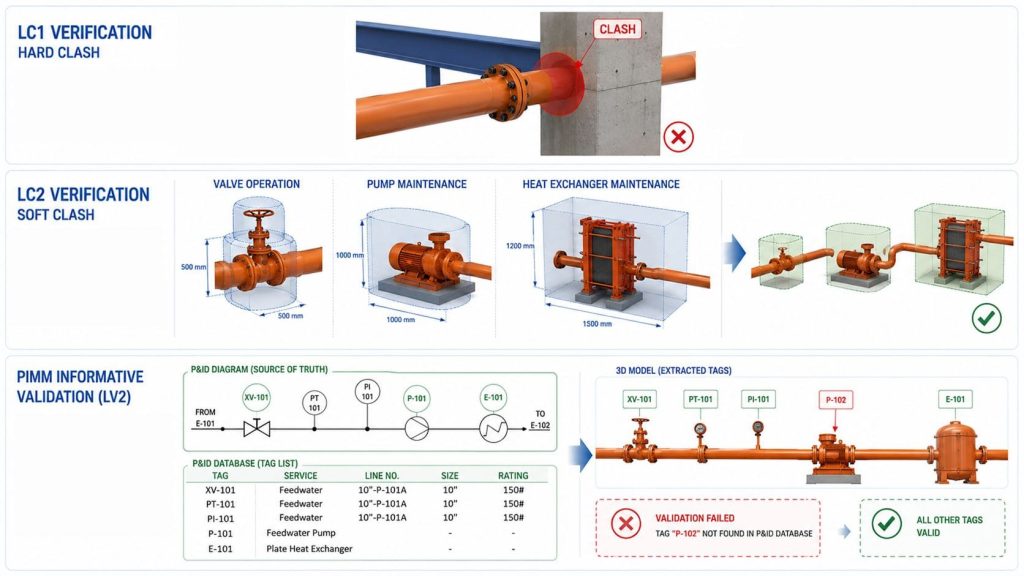
In addition to hard clashes between piping, structures and components, it becomes important to verify the functional volumes required for maintenance, accessibility and operation: the operating space of a valve, the extraction of a motor, the maintenance of a pump or the free volume required for a heat exchanger.

Informational validation is added to these geometric checks: the TAGs present in the 3D model must be consistent with those shown in P&IDs, datasheets and project lists.

If a valve is present in the 3D model but does not match the TAG indicated in the P&ID, the problem is not geometric but informational. The valve may not generate any interference, but it is still an unvalidated element: its rating, datasheet, position in the line and maintenance documentation may not be consistent with the process.

For an industrial plant, therefore, model quality does not depend only on the absence of interferences, but also on the consistency between the process diagram, 3D model, technical data and associated documentation.

From CAPEX to OPEX: towards a single source of truth for the plant

Many digital projects focus on the design and construction phase. However, for an owner operator, the value of information emerges especially during plant operation.

An industrial plant continues to evolve after handover: it undergoes maintenance, revamping, component replacements, process changes, regulatory updates and operational interventions. If the model delivered at the end of the project does not maintain a reliable connection with real technical data, it can quickly become an outdated snapshot of the plant.

PIMM helps reduce this risk because it focuses on data continuity: from P&ID to 3D model, from isometrics to construction, from datasheets to maintenance, all the way to asset operation.

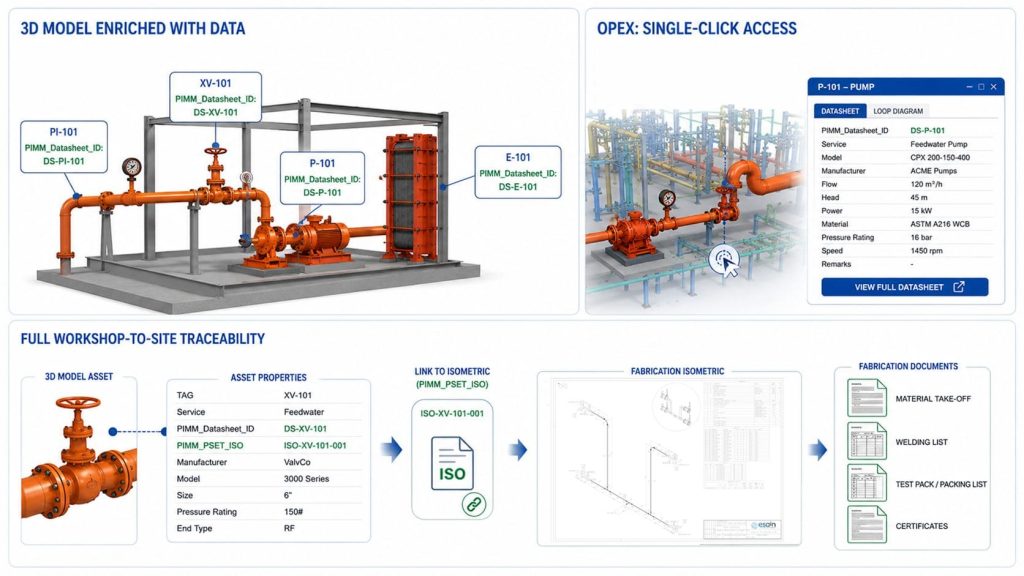
In an OPEX-oriented model, clicking on a valve, instrument or piece of equipment should not only show its position. It should make it possible to access its technical identity, datasheet, reference P&ID, installation documentation and information useful for maintenance, spare parts and future updates.

In this sense, PIMM helps create a “single source of truth” for the industrial plant: not a static document archive, but an information structure that keeps geometry, process, technical data and operational management connected.

Who benefits from PIMM?

PIMM is useful for all roles involved in the design, construction and management of industrial plants.

It helps process engineers and piping designers maintain a more consistent connection between P&IDs, technical data, piping classes and the 3D model. It offers BIM Managers a clearer criterion for integrating industrial objects into the federated model, without forcing building-oriented logic onto process systems.

For EPC contractors and owner operators, it reduces the risk of misalignment between disciplines, revisions and project outputs, making information more useful for construction, maintenance and revamping. For ICT, digital transformation teams, contracting authorities and clients, it provides a reference for integrating different tools and defining information requirements that are better aligned with industrial plant reality.

How ESAPRO supports a PIMM workflow

ESAPRO was created to support industrial plant design through integrated modules dedicated to process, 3D piping and electrical design.

With ESAPRO P&ID, the process diagram becomes a structured information base, not just a graphic deliverable. Lines, valves, instruments and equipment can be managed with associated data, lists and consistency checks.

With ESAPRO 3D Piping, the three-dimensional plant model is developed based on logics and specifications specific to industrial plant engineering, with particular attention to piping classes, components, layout, materials and technical outputs.

With ESAPRO Cable Trays, the electrical side can also be integrated into the plant design workflow, contributing to a multidisciplinary view of the project.

The value of the ESAPRO approach lies precisely in the connection between data, model and documentation. P&IDs, 3D, isometrics, bills of materials and technical information should not be managed as separate elements, but as parts of a single consistent process.

From this perspective, ESAPRO enables many PIMM principles in practice: connected data, more controllable models, reliable technical outputs, greater consistency between design phases and simpler management of plant information.

Towards more conscious management of plant information

Introducing PIMM does not mean adding complexity to the project, but clarifying which information is really needed, where it should be managed and how it should remain connected.

In industrial plants, complexity already exists: specifications, documents, TAGs, lists, revisions, isometrics, datasheets and maintenance requirements are part of the normal plant lifecycle. The point is not to create more data, but to better govern the data that is needed, preventing it from being dispersed across disconnected files, Excel sheets, overly heavy models or documentation that is difficult to update.

The future of digital design for industrial plants does not require a single software platform for everything, nor a contrast between BIM and specialist plant design tools. It requires interoperability, methodological clarity and collaboration between disciplines.

For engineering companies, EPC contractors and owner operators, adopting a PIMM approach means building clearer workflows, more reliable data and more useful models not only during design, but also during construction, maintenance and plant updates.

Want to understand whether your workflow is ready for a PIMM approach?

Talk to our team and discover how to manage P&IDs, 3D piping and technical documentation in a more integrated way.

Contact us

Similar posts

Best P&ID software with structured project data, native DWG, automatic lists, spec-driven design and revision control

Best P&ID Software: Key Criteria for Choosing the Right One

P&ID and 3D piping model representing the same industrial plant from complementary perspectives

Single Source of Truth for P&ID and 3D Piping: Reducing Rework and Data Silos

P&ID change management process to control revisions and reduce rework

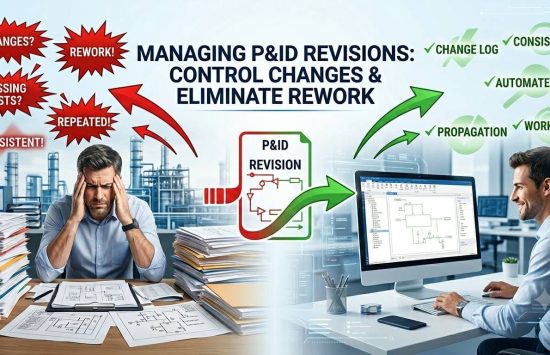
P&ID Change Management: How to Control Changes and Reduce Rework

The ESAPRO suite

Software for industrial plant design. 800+ clients and 4,000+ installations worldwide.

Discover the ESAPRO suite

Latest articles

See you at Ecomondo 2026

4 weeks ago

ESAPRO moves to the cloud: simpler, more flexible licensing

4 weeks ago

Summer office closure

2 months ago

Categories

News 17
Magazine 47
Logo-Esain-Anniversary-white

About us

Since 1994, ESAIN has developed integrated software for industrial plant design. The ESAPRO suite covers P&ID, 3D piping modelling and electrical design, with over 800 clients and 4,000 installations worldwide.

The Company has benefited from the resources of the PR FESR LIGURIA 2021-2027, Bando Digitalizzazione 1.2.3

Coesione_Italia_Liguria

Products

  • ESAPRO P&ID Software
  • ESAPRO 3D Piping Software
  • ESAPRO Cable Trays Software
  • Add-ons
  • Resold products

Services

  • Training and support

News

See you at Ecomondo 2026

4 weeks ago

ESAPRO moves to the cloud: simpler, more flexible licensing

4 weeks ago

Summer office closure

2 months ago

Case history

  • All case histories

Follow us

LinkedIn
YouTube

ESAIN s.r.l. · +39 010311544 · info@esain.it · Via de Marini 1, WTC 8th floor – 16149 Genoa, Italy

Share capital € 50,000 · REA GE-347489 · P. IVA 03470480108

  • Privacy
  • Cookie