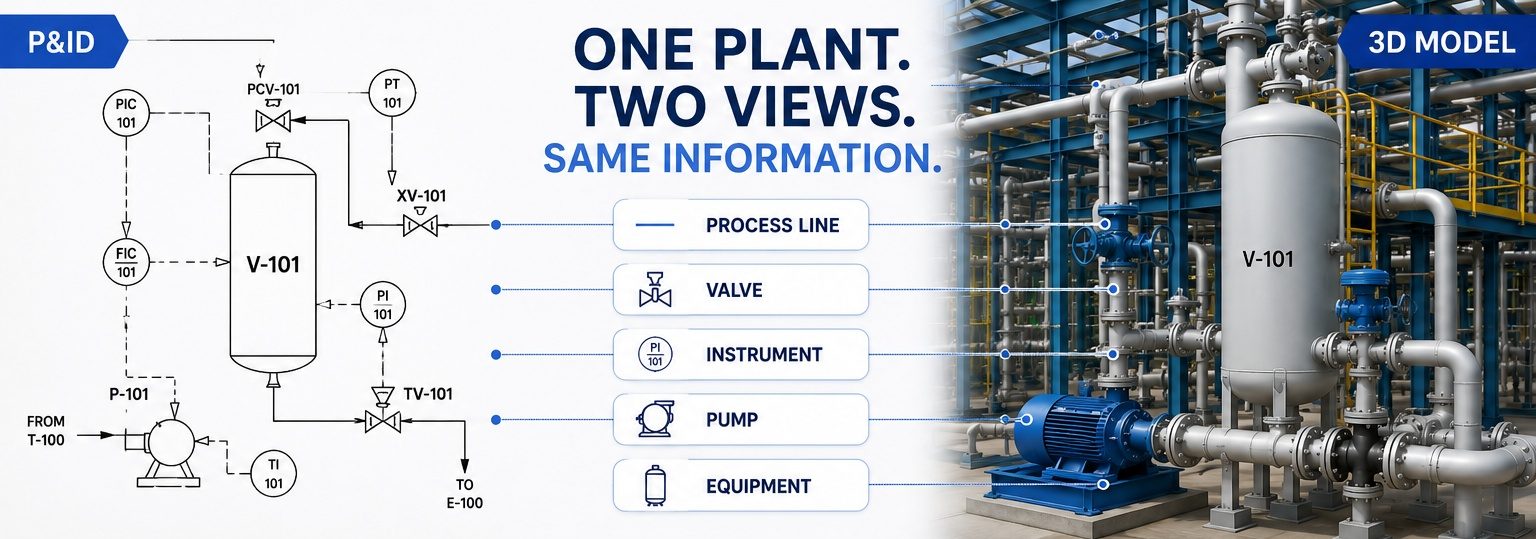
In an industrial project, the P&ID and the 3D piping model describe the same plant from two different but complementary perspectives.
The P&ID defines process logic, lines, equipment, valves and instrumentation. The 3D piping model represents the physical arrangement of those elements, showing how piping systems are routed through the plant and how they interact with equipment, structures, supports and other disciplines.
Both are essential. The challenge begins when they stop evolving consistently.
A line may exist in the P&ID but not yet be reflected in the 3D model. A diameter may be updated by one discipline but not by another. A valve may be replaced without the change being propagated throughout the related project documentation.
These situations rarely originate from design mistakes. More often, they arise because project information is managed across multiple documents, systems or teams, making it difficult to maintain alignment over time.
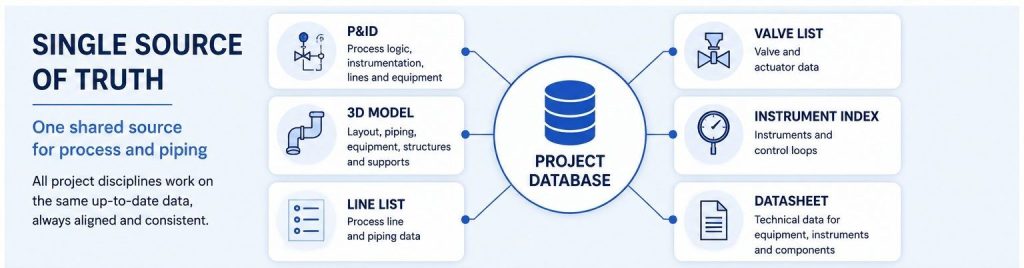
This is why many engineering organizations are increasingly focusing on two closely related concepts: Single Source of Truth and Engineering Data Management.
The goal is not simply to manage more information, but to ensure that process, piping and other disciplines can rely on the same technical data throughout the project lifecycle.
Why P&ID and 3D Piping Models Tend to Drift Apart
P&ID and 3D piping models are maintained by different disciplines, each with its own responsibilities, priorities and workflows.
Process engineers focus on process requirements, operating conditions and functional plant information. Piping designers focus on routing, constructability, space constraints and 3D modeling activities.
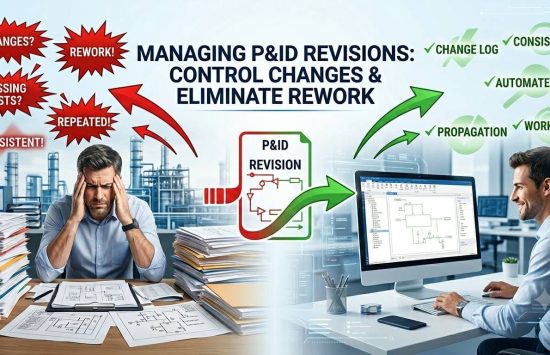
In addition, engineering projects rarely follow a perfectly linear path. HAZOP studies, risk assessments, design reviews, client requests and regulatory requirements can introduce changes even when the 3D model has already reached 70–90% completion. When this happens, updates made to the P&ID must also be reflected in the 3D model, related documentation and project deliverables.
Another common source of misalignment originates much earlier in the project lifecycle: technical assumptions are often defined during bidding and proposal phases, where engineering teams must balance technical requirements, budgets and competitive deadlines. As projects progress, those assumptions frequently evolve, requiring process and piping teams to realign information that was initially created under different constraints.
As information is updated, reviewed and shared across multiple disciplines, the risk of inconsistencies naturally increases.
The Hidden Cost of Poor Engineering Data Management
Many organizations view misalignment between P&IDs and 3D models as a technical issue but in reality, it is often an engineering data management issue.
The actual cost is rarely the time required to modify a drawing or update a model. The larger cost comes from verifying information, checking documents, validating revisions and coordinating activities across disciplines: these activities can consume hundreds of engineering hours that add no direct value to the design itself.
As projects grow, teams often spend increasing amounts of time answering questions such as:
- Which document contains the latest information?
- Has this change already been implemented in the 3D model?
- Is the line list still aligned with the latest P&ID revision?
- Have all affected disciplines been informed?
Individually, these tasks may require only a few minutes. Across hundreds of changes, however, they can consume a significant amount of engineering effort and become a major source of rework.