


Steel is a strategic material for engineering and industrial manufacturing. It is chosen for its combination of mechanical strength, workability, and long-term durability, characteristics that make it suitable for structural applications, mechanical components, industrial plants, and high-performance uses.
However, to select the most suitable type of steel for a specific application, such as when used as a material for piping, it is essential to know its chemical composition and physical properties. This is where a standardized system comes into play: the AISI steel grades classification.
The AISI grades of steel are among the most widely used systems internationally to identify and distinguish steel alloys precisely. From mechanical design to automotive component production, the AISI steel classification is a fundamental technical tool that allows professionals to navigate hundreds of different alloys, each with specific characteristics of strength, hardness, weldability, and corrosion resistance.
In this article, we will analyze the meaning and structure of the AISI steel grades, see how to interpret numerical codes, and understand how the main families are organized according to AISI standards.
What is the AISI Steel Classification
The AISI steel classification is a system developed by the American Iron and Steel Institute with the aim of standardizing the identification of different types of steel based on their chemical composition and metallurgical structure. But it is not a system limited to stainless steel (such as AISI 304 steel): the AISI steel grades also applies to carbon steels, low-alloy steels, and high-alloy steels.
The structure of the AISI standards is based on a numerical code generally composed of three or four digits. These digits uniquely classify each alloy, indicating the material’s main characteristics. For example, carbon steels belong to the 1XXX series, while stainless steels are included in the 2XX, 3XX, and 4XX series, depending on their microstructure and main alloying elements.
In industrial practice, the AISI steel grades allow easy distinction between an austenitic non-magnetic steel, such as AISI 304 (rich in chromium and nickel), a ferritic steel, or a more corrosion-resistant alloy such as AISI 316, which also contains molybdenum.
This coding system not only simplifies communication between designers, manufacturers, and suppliers but also enables targeted material selection based on the operating environment and required performance. In the design phase, digital tools like ESAPRO MTO support this selection by directly translating P&ID diagrams into structured material lists, facilitating the analysis of technical specifications and automatic generation of cost estimates.
The ESAin module is designed to precisely interpret piping specifications and automatically calculate the quantities of components such as flanges, fittings, bolts, and reducers, optimizing both time and accuracy in material estimation.
AISI Steel Grades Classification System
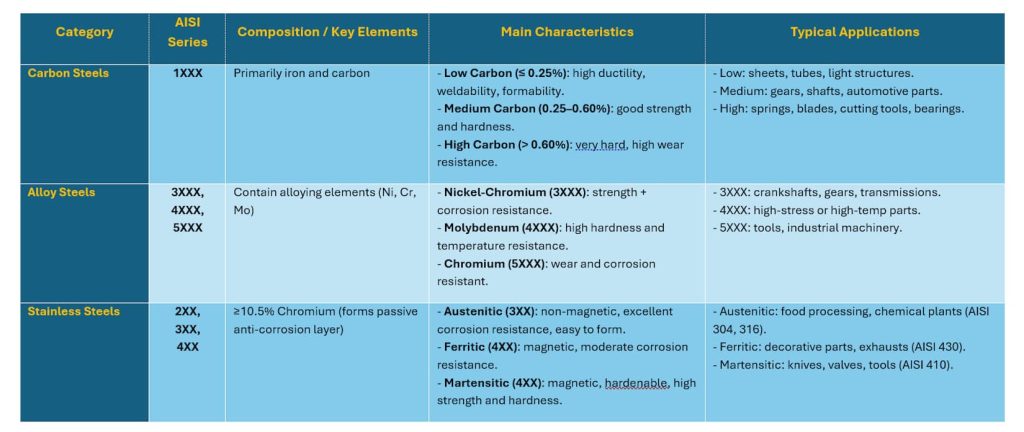
The standard AISI steel grades distinguish materials according to their chemical composition and structural properties, dividing them into three main families: carbon steels, alloy steels, and stainless steels. Each group is further subdivided based on alloy element content and mechanical behavior.
Carbon steels
Identified by the AISI 1XXX series, they are mainly classified according to their carbon content:
- Low carbon content (≤ 0,25%): used in products requiring good ductility, weldability, and formability. Widely used in the production of sheets, tubes, and light structural parts.
- Medium carbon content (0,25 – 0,60%): offer greater hardness and strength, ideal for automotive components, gears, shafts, and parts subjected to moderate stress.
- High carbon content (> 0,60%): characterized by high hardness and wear resistance, used for cutting tools, springs, blades, and bearings.
Alloy steels
Alloy steels contain additional elements such as nickel, chromium, or molybdenum, which modify their mechanical performance and resistance to fatigue, wear, or high temperatures. They are generally identified by four-digit codes.
- Chromium steels (5XXX series): resistant to wear and corrosion, used in industrial equipment and mechanical tools.
- Nickel-chromium steels (3XXX series): combine mechanical strength and corrosion resistance, suitable for transmission parts, crankshafts, and gears.
- Molybdenum steels (4XXX series): designed for applications under high thermal or mechanical stress, thanks to increased hardness and stability at high temperatures.
Stainless steels
These are a subclass of alloy steels, identifiable in the standard AISI 2XX, 3XX, and 4XX classifications. They contain at least 10.5% chromium, responsible for forming a passive surface layer that protects the metal from corrosion.
Depending on the crystalline structure, they are divided into:
- Austenitic (3XX series): rich in chromium and nickel, they are non-magnetic, highly corrosion-resistant, and easy to work. Examples: AISI 304, AISI 316.
- Ferritic (4XX series): magnetic, with good corrosion resistance, though lower than that of austenitics. Used for finishes and less critical components. Example: AISI 430.
- Martensitic (4XX series): hardenable steels that combine mechanical strength and hardness. They are magnetic and used for knives, cutting tools, and valves. Example: AISI 410.
This subdivision makes the AISI steel classification an essential tool for selecting materials based on stresses, usage environments, and the performance requirements of industrial applications.


