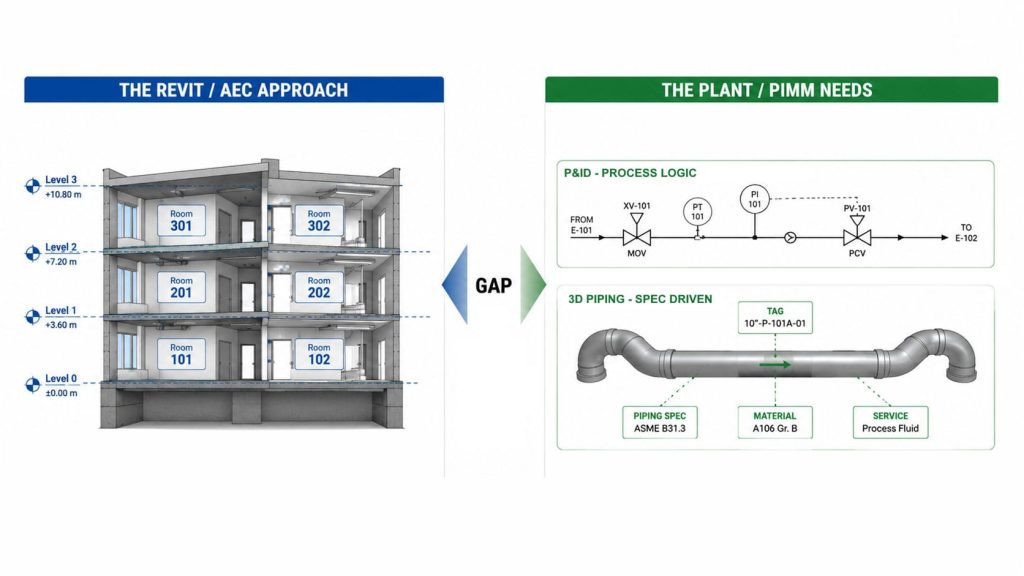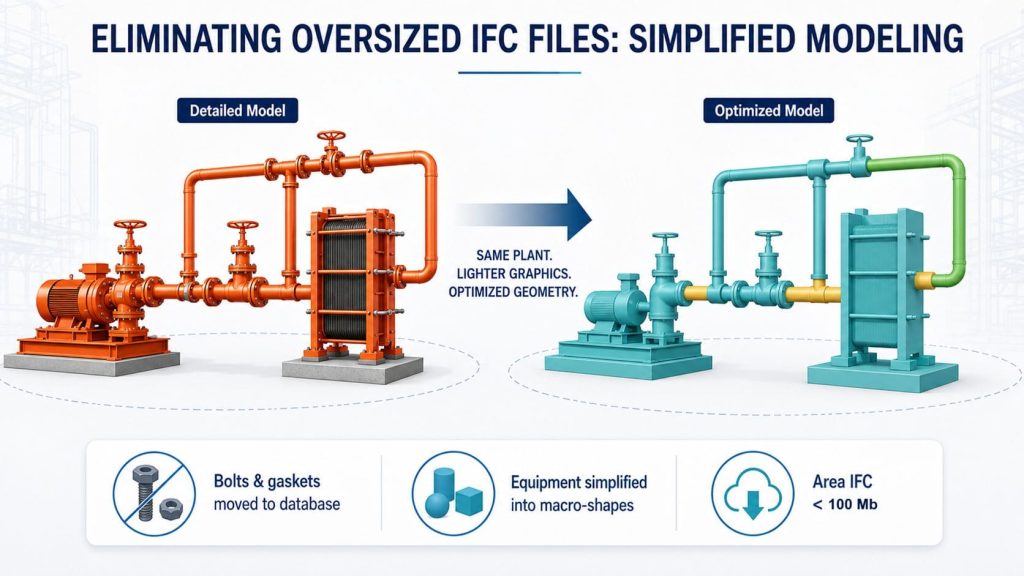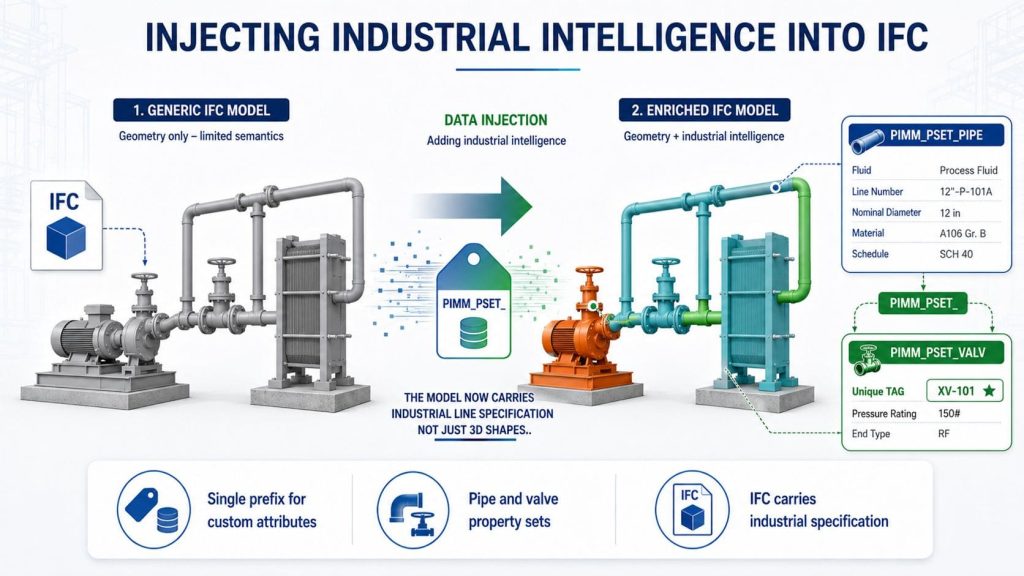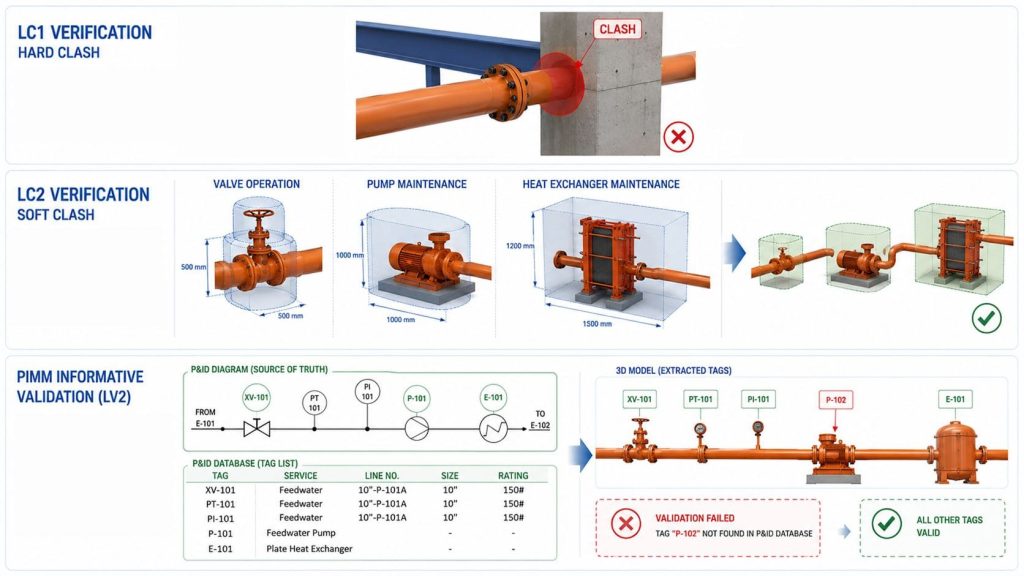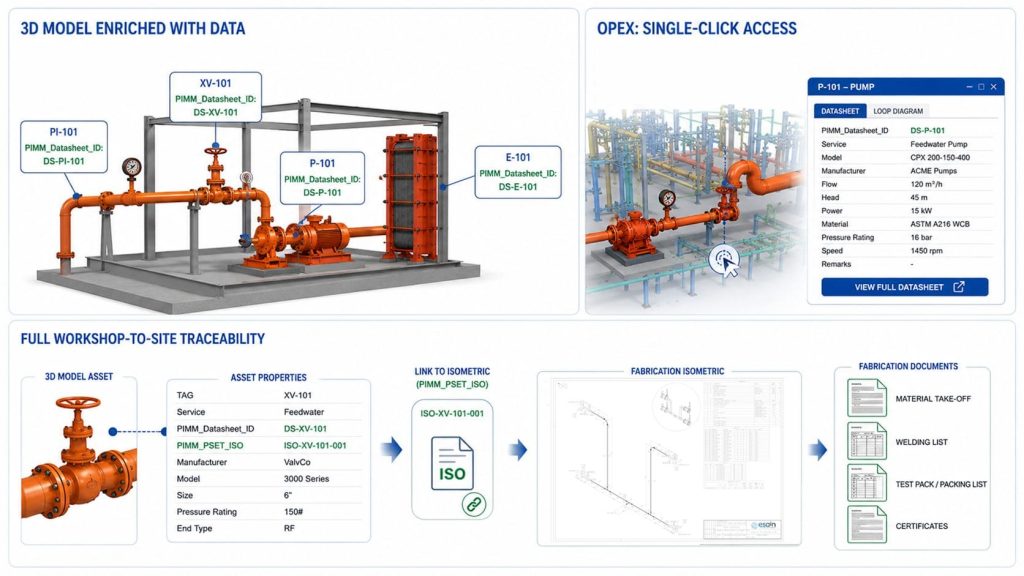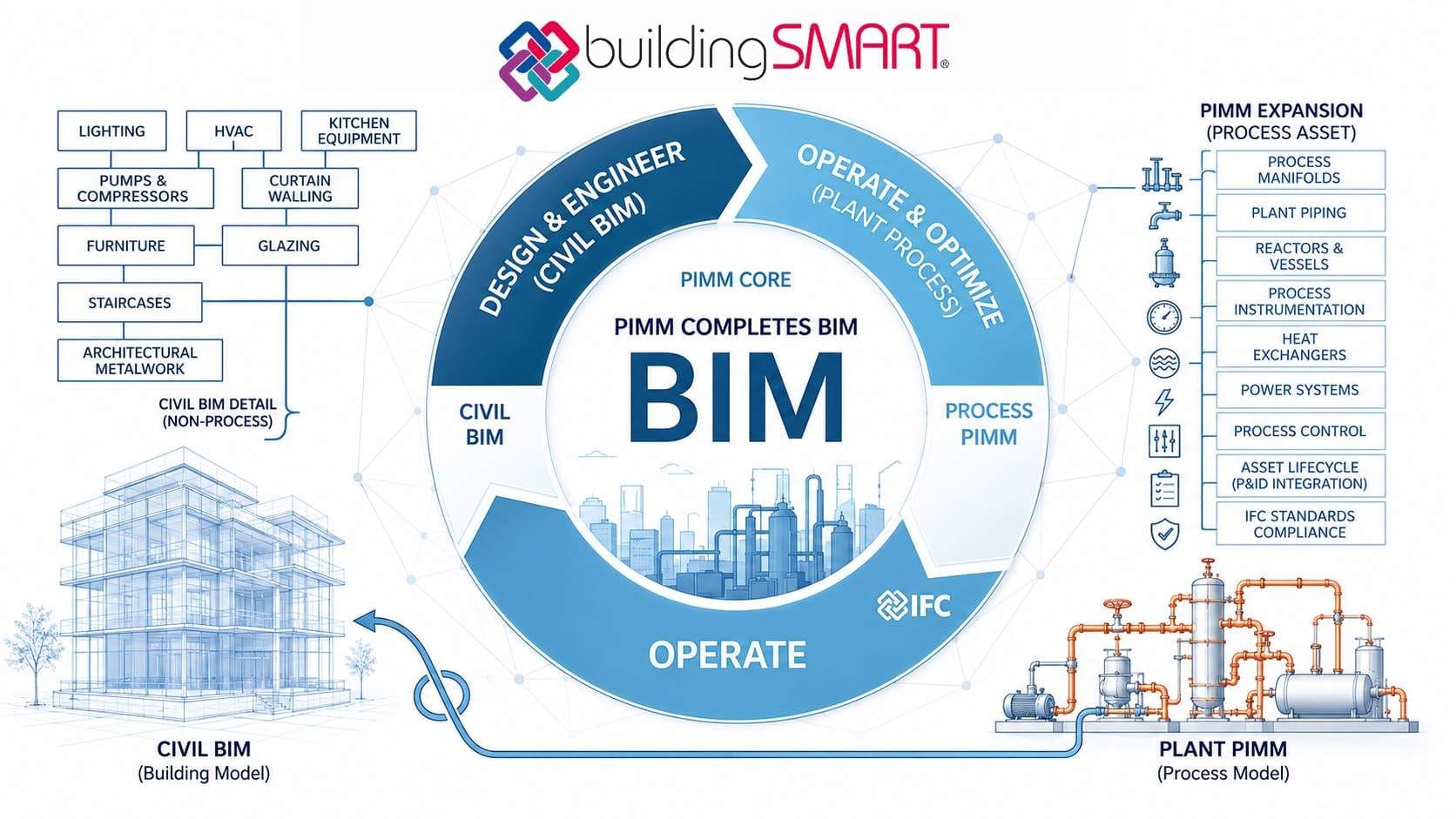
PIMM, Plant Information Modeling & Management, was created to provide information management that better fits the needs of industrial plants. In plant design projects, the value of the model does not depend only on geometry, but on the consistency between P&IDs, TAGs, piping data, 3D models, datasheets, IFC and technical documentation. PIMM does not replace BIM: it complements it in the management of the plant’s technological content, connecting process data, the federated model and the asset lifecycle.
In digital design, BIM introduced a fundamental change: the model is no longer only a geometric representation, but becomes a container of information that supports design, construction and asset management over time.
This approach has delivered major benefits in the civil, architectural and infrastructure sectors. However, when the information model is applied to industrial plants, process plants, piping networks, water treatment systems, energy plants or waste-to-energy facilities, specific needs emerge.
An industrial plant is not simply a building that contains pipes, equipment and instruments. It is a complex technical system governed by process logic, engineering data, line specifications, TAGs, P&IDs, datasheets, isometrics, bills of materials and maintenance documentation.
This is why the concept of PIMM, Plant Information Modeling & Management, becomes relevant.
If BIM manages the spatial and informational container of the asset, PIMM helps structure the plant’s technological content: the information that describes how the system works, how it is built, how it is updated and how it can be managed over time.
From this perspective, PIMM can also be seen as a connecting layer between BIM and the industrial Digital Twin. It does not intervene only at the end of the project, when the plant has to be handed over and managed, but helps build a consistent information base from the very beginning, connecting design to the future operation of the asset.
What is PIMM?
Plant Information Modeling & Management is an approach to digital information management applied to industrial and process plants.
It is not a regulatory standard, it is not a file format and it is not a single proprietary software platform. It is an open, software-agnostic methodological approach designed to structure, connect and validate industrial plant information within an interoperable digital ecosystem.
Its goal is to connect, in a consistent way:
- P&ID diagrams and process data;
- equipment, valve and instrument TAGs;
- line lists and piping classes;
- 3D plant models;
- isometric sketches and bills of materials;
- technical datasheets;
- project, construction and maintenance documentation;
- information useful for the future Digital Twin and O&M management.
Many PIMM principles are consistent with the information management already found in BIM processes. The difference lies in the specialization of the information content: in industrial plants, critical information is not only spatial or construction-related, but also derives from process, piping, specifications, technical documentation and operational logic.
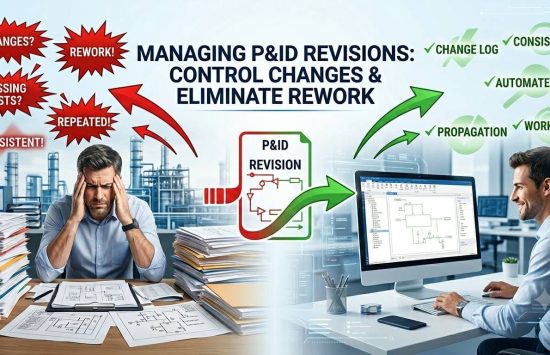
In a PIMM workflow, 3D geometry is not an isolated element: it is connected to an information structure in which every change to the process, lines, valves or instruments can affect documentation, materials, isometrics, layout, maintenance and operational safety.
Why BIM alone may not be enough for industrial plants
In its most common application in AEC, BIM is often used to manage buildings, infrastructure, spaces, structures, building components and coordination between disciplines.
In industrial plants, however, the focus of the project is often different.
The question is not only: “Where is this object in the model?”, but also: “Which P&ID is it connected to?”, “Which fluid does it carry?”, “What is its piping class?”, “Which datasheet describes it?” and “How will it be managed during operation?”
A 3D model can be correctly coordinated from a geometric point of view and, at the same time, lack the information needed to support construction, commissioning or plant maintenance.
For an industrial plant, a “clash free” model is not necessarily a model ready to be built or managed. Spatial consistency is essential, but it must be supported by engineering consistency: this is where PIMM becomes relevant.
From BIM to Digital Twin: the data handover challenge
One of the most discussed topics in asset digitalization is the relationship between BIM and Digital Twin. In many projects, BIM mainly supports design and construction, while the Digital Twin is associated with asset operation, integrating data from sensors, maintenance, IoT platforms and monitoring systems.
The transition between these two worlds is not always automatic.
At the end of construction, the information model should become a useful base for operation and maintenance. However, if data has not been properly structured from the earliest stages, handover can become complex, costly and partly manual: information must be retrieved, documents linked, attributes normalized, coding systems checked and systems integrated.
In the civil sector, this issue is already relevant. In industrial plant engineering it can become even more critical, because the operational value of the asset depends on very specific technical information: P&IDs, TAGs, piping classes, process data, datasheets, isometrics, materials, revisions and maintenance logic.
PIMM helps reduce this gap because it does not consider the Digital Twin as an information layer to be built only at the end of the project. Instead, it promotes consistent data management starting from the first process diagram, so that the engineering intelligence of the plant is maintained throughout its lifecycle.
In other words, while the 3D model represents the spatial configuration of the plant, the connected technical database preserves the logic that makes that plant buildable, verifiable and manageable.