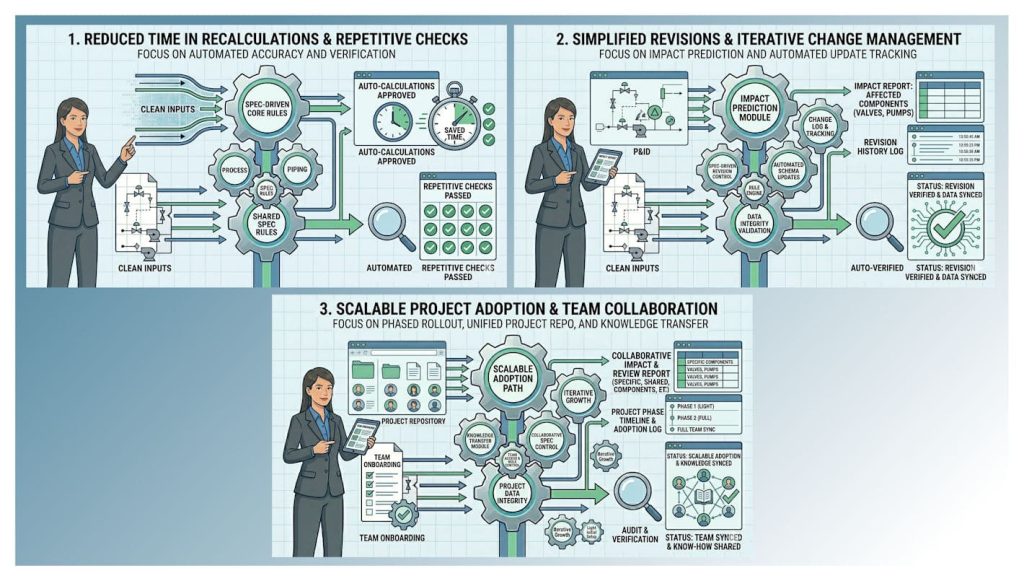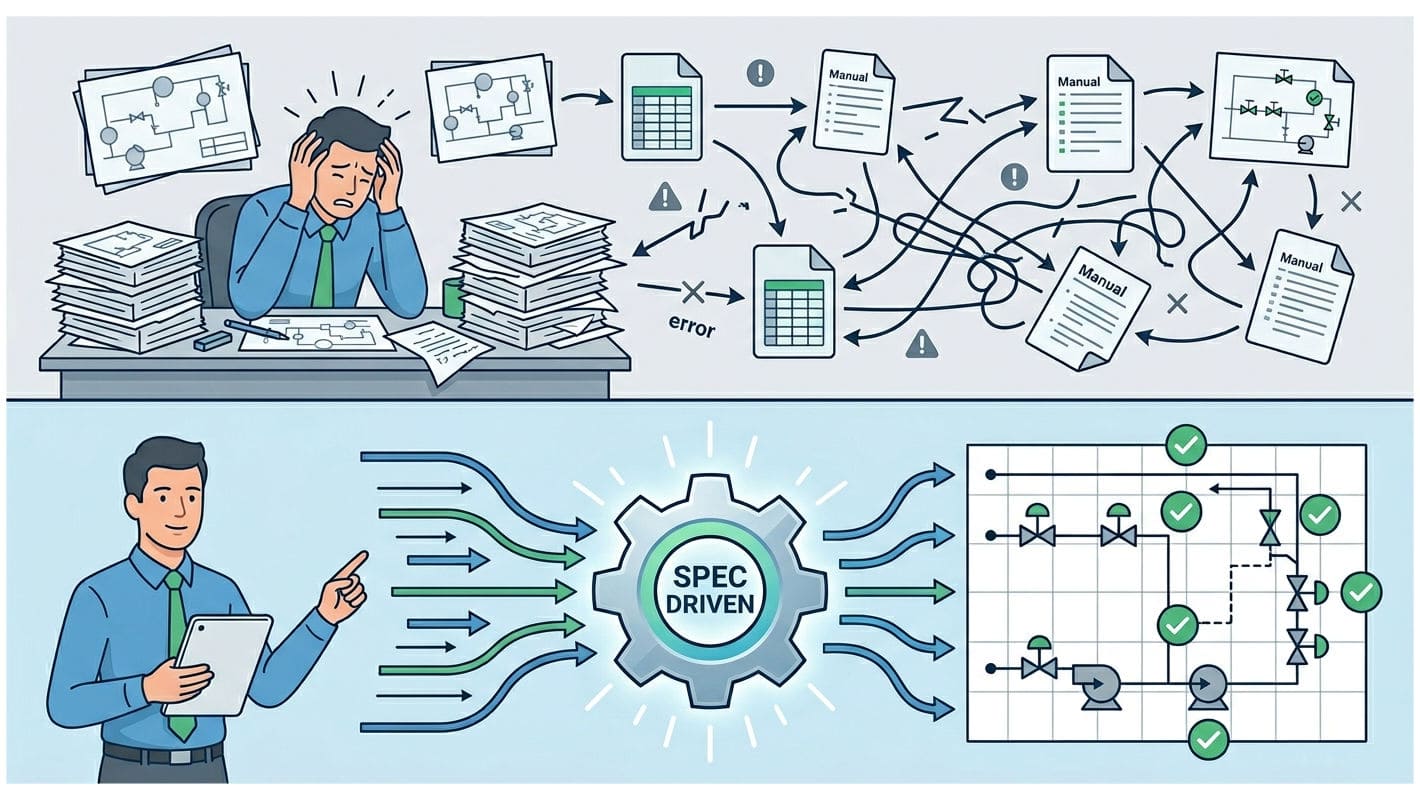
In many projects, the hard part is not “drawing” the P&ID. The heavy work comes afterwards: revisions, checks, alignment across documents, and repetitive fixes whenever a requirement changes.
A P&ID spec driven approach is meant to reduce that burden. The idea is simple: recurring choices in every job (keeping lines and components consistent with shared rules) should not rely on notes, memory, or copy-paste into spreadsheets maintained by hand. They should be governed by specifications.
That is where the concept of piping spec comes in. A piping spec is the specification (or class) assigned to a family of lines, the rule that defines how that line (and the connected components) should be handled. In many organizations, the same concept is also called pipe spec, pipe class or piping class, and more broadly as part of a set of piping specifications used to keep decisions consistent across the project.
In a P&ID, what matters most is that this rule is clear and applied consistently, because that is what makes the spec driven approach truly valuable during revisions. In a data-driven P&ID workflow, that consistency can be managed as project data (not as a note). This is the approach supported by ESAPRO P&ID.
What “spec driven” means in a P&ID
Spec driven does not mean adding more text to the drawing. It means that, when working on the P&ID, you assign a rule to the lines (the piping spec/pipe spec) and manage the rest in a way that stays consistent with that choice.
The benefit is not having more information. The benefit is reducing uncontrolled variations and making it easier to identify what has changed when a revision is issued, particularly in projects that require a structured change management process.
In a non-spec-driven workflow, many checks happen after the fact: someone notices a component is not consistent, spreadsheets and notes are opened, revisions are reviewed, and time is lost. In a spec-driven workflow, the piping spec becomes a stable reference: when a rule changes, it is easier to see where it impacts the project and what needs to be verified.