


In 1824, an insight paved the way for a method of protecting metals that, even today, remains a standard across various industrial sectors. Sir Humphry Davy, an English chemist, was the first to propose the idea of defending a metal structure—specifically the copper hull of a ship—by attaching blocks of iron to it, thereby diverting the corrosive action of the marine environment onto these blocks instead.
Although rudimentary, the experiment anticipated one of the fundamental principles of cathodic protection: sacrificing a less noble metal to preserve one that is more exposed.
Since then, the technology has evolved, but the objective has remained unchanged: a cathodic protection system for industrial pipelines enables the safeguarding of metal structures, particularly those buried or submerged, from damage caused by continuous contact with electrolytic environments such as moist soils, groundwater, or seawater.
Pipes, tanks, metal foundations: every infrastructure operating under these conditions is subject to progressive deterioration due to corrosion. And this degradation is not merely an issue of lifespan or aesthetics; it can pose safety risks, lead to unforeseen maintenance costs, and cause operational interruptions.
Cathodic Corrosion Protection in industrial plants addresses precisely this point: it neutralises or slows down the corrosive action by acting on the electrical potential of the structure to be protected. It is not a surface treatment or a physical barrier, but an electrochemical system capable of altering the behaviour of the metal at a molecular level.
It is an established technology, used on a global scale, which has proven to be effective in preventing damage even in particularly challenging environmental conditions.
In the following sections of this article, we will look in detail at what is cathodic protection for pipes, distinguishing between the two main methods by which it is implemented.
What is Cathodic Protection for industrial pipelines
Cathodic protection for pipelines, is a technical solution designed to minimize the corrosion that affects buried or submerged metal pipes in humid or aggressive environments, such as conductive soils or groundwater.
When referring to a cathodic protection system for industrial pipelines, we mean a set of measures capable of preserving the integrity of steel or iron pipes over time, such as those used for water piping, which are subject to slow but constant deterioration due to contact with the surrounding electrolyte.
This technology does not completely halt the corrosive process but greatly limits its progression, keeping the material in a stable and less vulnerable electrical potential state. It is a common practice in the field of underground infrastructure and has become an integral part of the design and management of any cathodic protection system involving water networks, gas pipelines, oil pipelines and industrial systems.
When correctly applied, pipe cathodic protection for industrial plants not only preserves the functionality of the network, but also reduces corrective interventions and expenses related to faults or leaks. In particular, in systems serving water distribution, cathodic protection of water pipelines plays a strategic role: it prevents infiltration, extends the useful life of the lines, and contributes to the operational sustainability of the plants.
The approach to pipeline cathodic protection is based on well-established electrochemical principles, but requires careful design in order to be effective: each system must consider the characteristics of the soil, the type of metal to be protected, and the operational conditions of the pipeline. This is why, when asked “What is cathodic protection?”, the answer cannot be purely technical: it is a long-term strategy aimed at securing essential infrastructure.
From this perspective, meticulous design of a system plays a crucial role not only in ensuring functionality, but also in the effectiveness of pipe protection systems. Nowadays, the ability to model pipelines, supports, isometric sketches in detail and to check pressure losses is entrusted to advanced digital tools.
Among these, plant design software offers a suite of applications tailored for the three-dimensional modelling of piping systems, also integrating specific modules for analysis, materials management, and features that allow the export of 3D geometries to the most widely used stress analysis software. This provides concrete support for those designing complex plants who wish to integrate effective solutions right from the outset.
How does Cathodic Protection work on pipelines
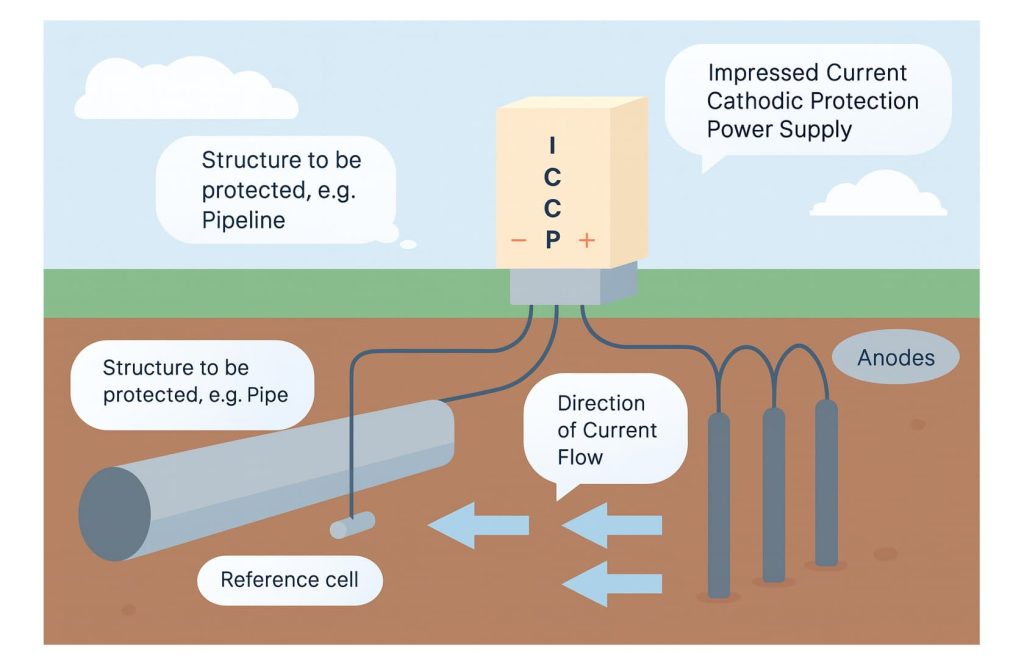
The foundation of cathodic corrosion protection lies in an electrochemical principle: transforming the metal structure to be protected – such as buried pipelines – into a cathode, making it less reactive and therefore resistant to corrosion. This effect is achieved by inducing a current that alters the electrical potential of the metal surface, preventing the exchange of electrons that causes deterioration.
There are two main approaches to protecting pipelines and metallic infrastructure exposed to electrolytic environments: the use of galvanic anodes and impressed current systems (ICCP). Both aim for the same objective but differ in terms of technology, power, and applications.
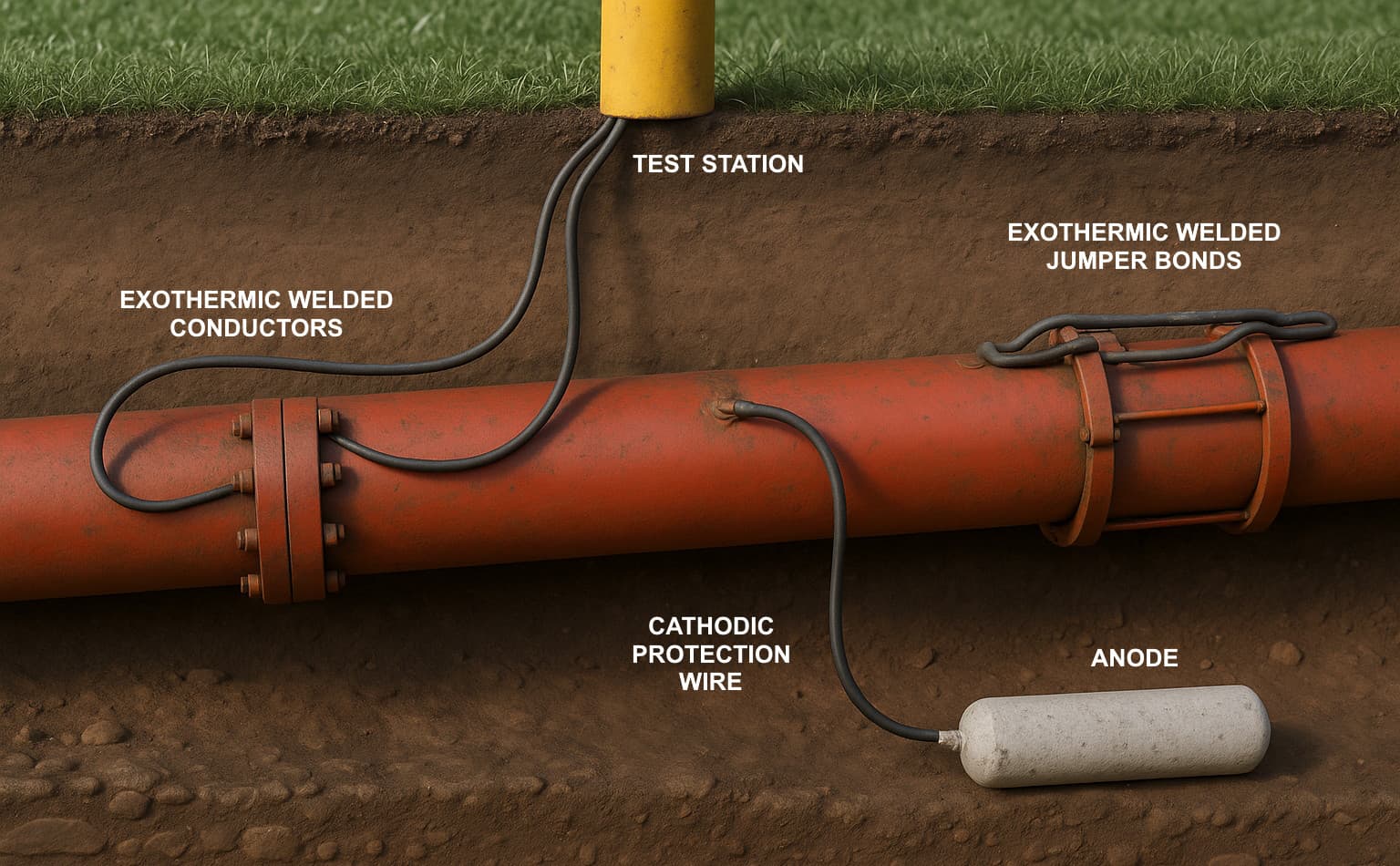
In the first case, also known as galvanic cathodic protection, the system relies on metals that are more reactive than the one being protected. Zinc, magnesium, and aluminium are among the most used materials for these anodes, which gradually wear away, releasing electrons to the benefit of the pipeline. The metal of the structure thus remains stable, while the anode corrodes in its place. This is a self-sufficient solution that does not require an electrical power supply and is often chosen for sections of water pipelines or gas mains located in remote areas or where electrical systems are unavailable.
The second method is that of impressed current. In this case, a direct current generator is used, which, through inert anodes – such as coated titanium or graphite – keeps the metal in a protective potential condition. This approach allows for the management of complex systems, the protection of long stretches, and the adjustment of the protection intensity according to the condition of the soil and the coating of the pipeline.
The choice between galvanic protection and an impressed current cathodic protection system depends on several factors: the size of the infrastructure, the nature of the electrolyte, the type of coating, the expected lifespan of the system, and accessibility for maintenance. In any case, whether offshore or on land, a well-designed system can ensure decades of protection and drastically reduce the risk of corrosion to metal pipelines.
Costs and industrial applications of cathodic protection
To complete the picture, it is also useful to consider the economic aspects related to choosing a cathodic protection system. Costs vary significantly depending on several factors: from the size of the pipeline to the complexity of the system, including the characteristics of the soil (such as moisture, salinity and electrical resistivity) and the type of solution adopted.
Galvanic systems, which are simpler to install and suitable for short stretches or less critical situations, have a lower initial cost but may require more frequent replacement of the anodes. On the other hand, an impressed current system involves a higher upfront investment but provides more precise control, longer-lasting protection and lower management costs throughout the life cycle of the installation.
This technology is used in numerous industrial sectors. It is essential in gas and oil transportation networks, water and wastewater treatment systems, as well as in the energy field to protect buried metal structures and distribution plants. It is also employed in the maritime industry to safeguard docks, quays and offshore platforms, and in large civil infrastructure such as bridges and airports, where corrosion can compromise structural safety and increase maintenance costs.


