• About us
en
ites
  • Plant Design Software
    • ESAPRO Suite
      • Process Design
      • Plant Design
      • Electrical Design
      • Add-ons
    • Resold Products
  • Training and Support
  • Case histories
  • About us
  • News
    • All
    • News
    • Magazine
  • Contact
    • Contact us
    • Request Demo
    • Work with us
Request Demo
Magazine

P&ID spec driven: how to set up piping spec rules to reduce errors

Posted on 18 May at 9:44
Francesco Pais
P&ID spec driven how to set up piping spec rules to reduce errors

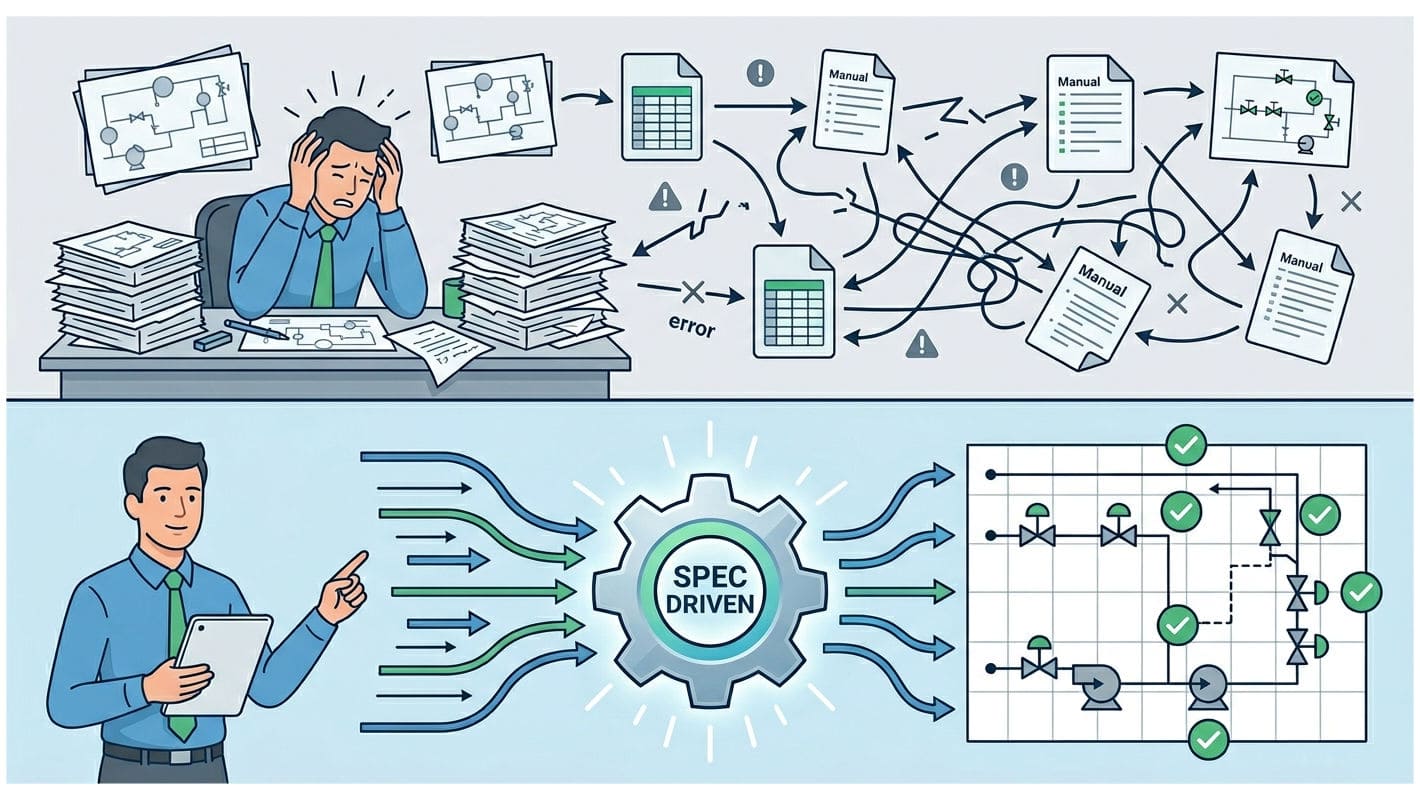
In many projects, the hard part is not “drawing” the P&ID. The heavy work comes afterwards: revisions, checks, alignment across documents, and repetitive fixes whenever a requirement changes.

A P&ID spec driven approach is meant to reduce that burden. The idea is simple: recurring choices in every job (keeping lines and components consistent with shared rules) should not rely on notes, memory, or copy-paste into spreadsheets maintained by hand. They should be governed by specifications.

That is where the concept of piping spec comes in. A piping spec is the specification (or class) assigned to a family of lines, the rule that defines how that line (and the connected components) should be handled. In many organizations, the same concept is also called pipe spec, pipe class or piping class, and more broadly as part of a set of piping specifications used to keep decisions consistent across the project.

In a P&ID, what matters most is that this rule is clear and applied consistently, because that is what makes the spec driven approach truly valuable during revisions. In a data-driven P&ID workflow, that consistency can be managed as project data (not as a note). This is the approach supported by ESAPRO P&ID.

What “spec driven” means in a P&ID

Spec driven does not mean adding more text to the drawing. It means that, when working on the P&ID, you assign a rule to the lines (the piping spec/pipe spec) and manage the rest in a way that stays consistent with that choice.

The benefit is not having more information. The benefit is reducing uncontrolled variations and making it easier to identify what has changed when a revision is issued, particularly in projects that require a structured change management process.

In a non-spec-driven workflow, many checks happen after the fact: someone notices a component is not consistent, spreadsheets and notes are opened, revisions are reviewed, and time is lost. In a spec-driven workflow, the piping spec becomes a stable reference: when a rule changes, it is easier to see where it impacts the project and what needs to be verified.
Is a spec driven approach in the P&ID really worth it?

Is a spec driven approach in the P&ID with piping spec really worth it

Working in a spec-driven way means using the piping spec as a shared rule, instead of relying on notes and manual verification. This makes it easier to keep consistency between lines and components and, above all, to manage revisions without rechecking everything “by eye.”

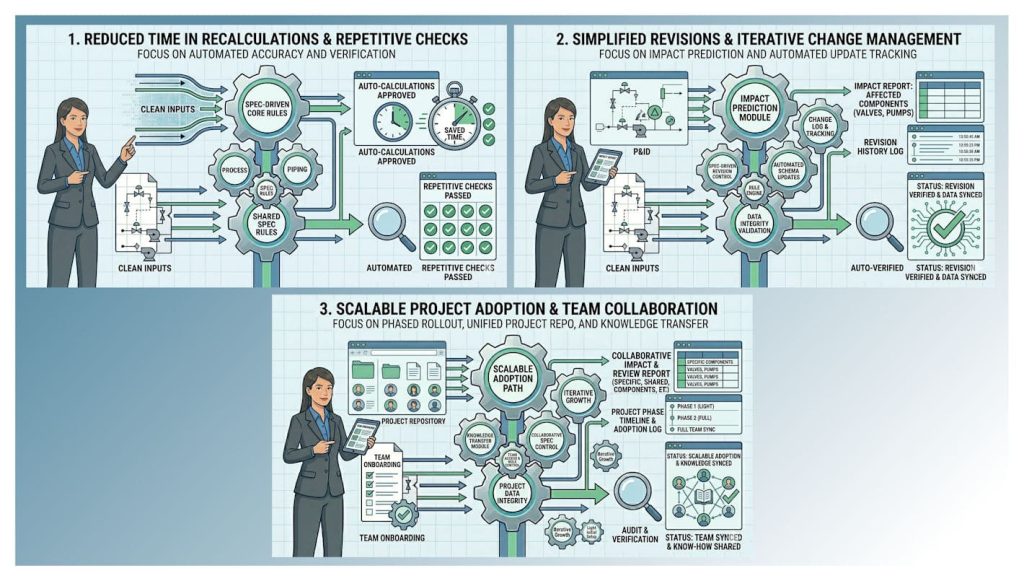
In practice, it connects to three typical outcomes:

  1. Less time spent on recalculations and repetitive checks
    When rules are clear and applied consistently, one-by-one verification after every change decreases. This is the kind of work that slows down even experienced teams, especially when revisions keep coming.
  2. Easier consistency across process, piping, and instrumentation
    The P&ID is a handoff point between disciplines. If consistency is not governed, misalignments surface late. Shared rules reduce the cases where documents drift apart without anyone noticing.
  3. More sustainable adoption (especially for SMEs)
    Spec driven works when the method is practical not when it only exists “on paper.” Starting light and having hands-on support during initial setup often makes the difference between a rule that is used and a rule that gets ignored.

Piping specifications in the P&ID: how to start simply

A solid approach, especially for SME teams, is to start “light” and iterate.

  1. Define a small set of piping specifications (pipe specs)
    A few clear rules are better than many rules that people do not use. The goal is to cover most real project cases, not to anticipate every exception.
  2. Decide what must stay consistent already at the P&ID stage
    You do not need to replicate the full detail design specification in the P&ID. But you do need to avoid ambiguity: if a line is associated with a spec, that choice should be clear and stable.
  3. Handle exceptions explicitly
    Exceptions always exist. The goal is to make them visible as exceptions (intentional decisions), not as accidental inconsistencies.
  4. Give revisions a simple rule
    When an input changes (client requirements, standards, constraints), make the impact readable: which lines are involved, and what decisions need to be checked again?

When a piping spec changes: what to check in the P&ID

The “easy” revisions are the ones where you add a line or update a tag. The revisions that cost time are the ones where a rule changes—e.g., a material, rating, or standard requirement for a family of lines.

At that moment, the risk is twofold:

  • updating the P&ID “in pieces,” leaving scattered inconsistencies;
  • spending hours figuring out what was actually impacted.

With a spec-driven approach, the revision tends to become more linear:

  • you identify which lines were associated with that rule;
  • you distinguish what remains compliant from what needs verification;
  • you reduce dependency on extensive manual checks.

This upstream control also shows up in the operational lists derived from the P&ID, such as the P&ID Line List, Valve List, and Instrument Index.

Where a data-driven P&ID software helps (and why it matters)

Spec driven is a method. To apply it consistently, you also need a tool that treats the P&ID as data—not only as graphics: attributes attached to objects, consistency checks, and stronger change management.

This is the approach behind ESAPRO P&ID: a P&ID module focused on data management, integrity, and class control, with the ability to produce consistent outputs. In practice, the goal is to reduce time spent on repetitive tasks that often end up in external files (counts, updates, checks), keeping the work closer to the P&ID and its rules.

Checklist: are you really working spec driven?

If you want to assess whether your workflow is spec driven (or just “spec driven” in theory), these questions help:

  1. Is the piping spec clear and shared, or does it live in notes and habits?
  2. Are exceptions recognizable and managed, or do they surface late during revisions?
  3. When a value in the piping spec changes, is it clear which lines are impacted?
  4. Does cross-discipline consistency still require extensive “by-eye” checking?
  5. Is the method sustainable for the team (simple adoption, practical rules)?

In a spec-driven P&ID, the piping spec is not a side detail: it is the rule that keeps lines and components together when the project changes. The result is a cleaner revision process, fewer by-eye checks, fewer late inconsistencies, and less manual work on checking, updating, and realigning after a change.

Do you want to see a spec-driven approach in action on a P&ID?

One of our experts will show you how to reduce time, errors, and manual work with a guided demo.

Request a demo

Similar posts

Best P&ID software with structured project data, native DWG, automatic lists, spec-driven design and revision control

Best P&ID Software: Key Criteria for Choosing the Right One

PIMM Plant Information Modeling & Management as a connection between BIM and the industrial Digital Twin

PIMM: Plant Information Modeling & Management for Industrial Plants

P&ID and 3D piping model representing the same industrial plant from complementary perspectives

Single Source of Truth for P&ID and 3D Piping: Reducing Rework and Data Silos

The ESAPRO suite

Software for industrial plant design. 800+ clients and 4,000+ installations worldwide.

Discover the ESAPRO suite

Latest articles

See you at Ecomondo 2026

4 weeks ago

ESAPRO moves to the cloud: simpler, more flexible licensing

4 weeks ago

Summer office closure

2 months ago

Categories

News 17
Magazine 47
Logo-Esain-Anniversary-white

About us

Since 1994, ESAIN has developed integrated software for industrial plant design. The ESAPRO suite covers P&ID, 3D piping modelling and electrical design, with over 800 clients and 4,000 installations worldwide.

The Company has benefited from the resources of the PR FESR LIGURIA 2021-2027, Bando Digitalizzazione 1.2.3

Coesione_Italia_Liguria

Products

  • ESAPRO P&ID Software
  • ESAPRO 3D Piping Software
  • ESAPRO Cable Trays Software
  • Add-ons
  • Resold products

Services

  • Training and support

News

See you at Ecomondo 2026

4 weeks ago

ESAPRO moves to the cloud: simpler, more flexible licensing

4 weeks ago

Summer office closure

2 months ago

Case history

  • All case histories

Follow us

LinkedIn
YouTube

ESAIN s.r.l. · +39 010311544 · info@esain.it · Via de Marini 1, WTC 8th floor – 16149 Genoa, Italy

Share capital € 50,000 · REA GE-347489 · P. IVA 03470480108

  • Privacy
  • Cookie